How to Select Flame‑Retardant Accessories?
Safety Clothing Fabric · Full Guide
Selection Pain Points: Weaknesses in Safety Clothing Often Lie in Accessories
When sourcing flame‑retardant protective clothing, most enterprises focus heavily on fabric test reports, while treating accessories such as zippers, sewing threads, webbings, reflective tapes and hook‑and‑loop fasteners as ordinary spare parts. They assume qualified fabric guarantees full‑garment safety. However, practical applications frequently reveal the following problems:
- Fabric passes all tests, yet mismatched accessory flame‑retardant performance causes seam melting, zipper tape thermal shrinkage and reflective‑tape peeling under high temperature, creating dangerous protection gaps.
- Products pass initial lab tests, but flame‑retardant performance of accessories degrades rapidly after repeated industrial laundering, leaving protective clothing ineffective in later service.
- Buyers only check for a "flame‑retardant" label without verifying thermal stability and mechanical strength. Accessories may meet flame‑retardant requirements but break easily under mechanical stress.
- For export orders, only fabric compliance with NFPA, ASTM or EN standards is verified. Non‑compliant accessories lead to full‑order certification failures, rework and financial losses.
Protective clothing follows the bucket‑effect principle: overall safety is determined by the weakest component. Even premium fabric cannot deliver full protection if accessories are poorly matched.
Core Judging Criteria for Flame‑Retardant Accessories
Do not judge accessories merely by whether they are flame‑retardant. Five key indicators should be evaluated. Request third‑party test reports instead of relying on verbal promises.
Core Indicator Key Evaluation Requirements Flame retardancy & thermal stability Meet standard requirements for after‑flame time, after‑glow time and damaged length; no molten dripping; low thermal shrinkage to avoid structural deformation under heat Washing durability Check performance before and after industrial washing cycles. Confirm retention of flame‑retardant property, adhesion and mechanical strength over the service life of workwear Mechanical performance Sufficient breaking strength for sewing threads and webbings; fatigue resistance for hook‑and‑loop fasteners; strong adhesion for reflective tapes to ensure structural integrity under stress Performance compatibility Flame‑retardant and thermal performance of accessories shall match the main fabric. Avoid mismatching high‑grade fabric with low‑performance accessories Regulatory compliance Comply with GB 8965.1‑2020 for domestic projects; satisfy NFPA 2112, ASTM F1506, EN ISO 11612 and other target‑market standards for export goods 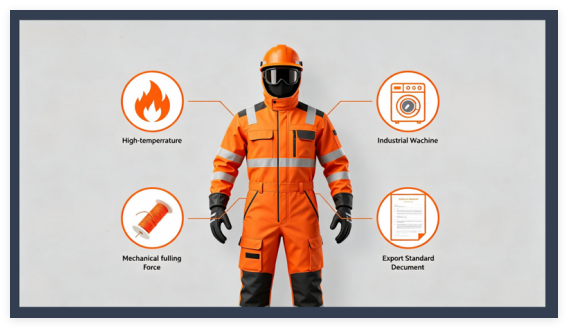
Comparison of Two Mainstream Flame‑Retardant Accessory Solutions
Two mainstream technical routes are available: Aramid intrinsic flame‑retardant and post‑treatment flame retardant accessories. Their flame‑retardant mechanisms and comprehensive performance differ significantly.
Comparison Dimension Aramid Intrinsic FR Accessories Post‑treatment FR Accessories Flame‑retardant mechanism Inherent flame‑retardant property from aramid fiber molecular structure Flame resistance achieved by surface flame‑retardant agents Flame‑retardant durability Permanent flame retardancy unaffected by laundering Decent initial performance; affected by washing and friction Thermal stability Excellent thermal stability; no molten dripping under heat Basic high‑temperature resistance Mechanical property High mechanical strength with outstanding friction and aging resistance Meets conventional strength requirements Cost level Relatively higher overall cost Cost‑effective with stable supply Suitable Application Scenarios
🔥 Aramid Intrinsic FR Accessories
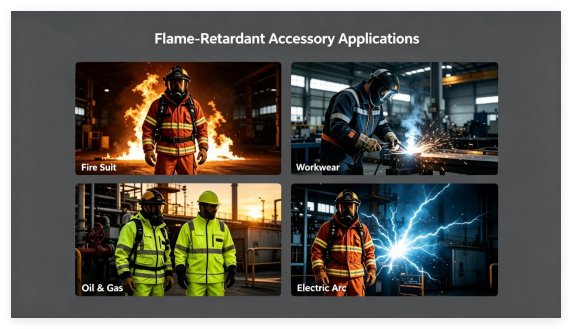
Designed for high‑risk positions including fire‑fighting, electric‑arc exposure, heavy‑duty welding and oil‑gas exploration. Recommended for garments requiring frequent industrial laundering and export products subject to strict NFPA, ASTM and EN requirements. It maintains stable structural integrity and consistent protection throughout the product lifecycle.
- Firefighting suits · Arc flash PPE
- Heavy welding · Oil & gas field wear
- High‑durability export orders
🧵 Post‑treatment FR Accessories
Suitable for general‑purpose workshop protection, incidental welding operations and low‑risk in‑house workwear. Ideal for mass‑production projects with low washing frequency and cost‑control priorities. It satisfies basic domestic protective standards for ordinary‑risk working environments.
- Daily workshop uniforms
- Low‑frequency washing garments
- Cost‑sensitive bulk procurement
Product Advantages of Frefr Flame‑Retardant Accessories
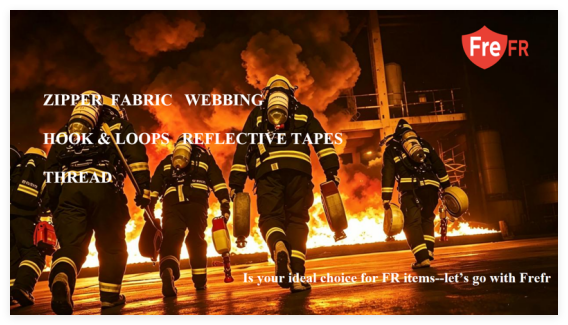
Frefr offers a complete portfolio of six flame‑retardant accessories: flame‑retardant zippers, sewing threads, webbings, reflective tapes, hook‑and‑loop fasteners and fabrics. Both post‑treatment and aramid intrinsic series are available for diverse project selections.
- Aramid intrinsic series: Consistent base‑material performance across all items. Thermal properties are well‑matched with protective fabrics. Excellent washing and aging resistance complies with stringent domestic and international standards, mitigating local protection failure caused by inconsistent accessory performance.
- Post‑treatment series: Stable performance and reliable mass‑supply capacity. Meets basic protective test requirements for mass‑produced general‑purpose workwear.
Full‑range accessories are developed in‑house. Customers can source all needed protective accessories from one supplier , reducing costs for component selection, testing and supply‑chain coordination.
Frequently Asked Questions — FR Accessories
Q: If the fabric passes flame-retardant tests, is the whole garment definitely safe?Not necessarily. Protective clothing follows the bucket effect: overall safety depends on the weakest accessory. Even if the fabric passes, if zippers, threads, or reflective tapes have poor FR or thermal stability, they may melt, shrink, or peel under heat, creating gaps. All accessories must be systematically evaluated.Q: How can I quickly tell if FR accessories are suitable for industrial laundering?Check “industrial washing durability” data in third‑party test reports — focus on retention of FR property, adhesion and mechanical strength after multiple wash cycles. Prefer intrinsic FR (e.g., aramid) accessories, as their FR is unaffected by washing; for post‑treatment, confirm that performance decay is within acceptable limits over the expected wash cycle.Q: Which international standards must FR accessories meet for export garments?Common standards include: NFPA 2112 (industrial fire‑protective), ASTM F1506 (arc flash), EN ISO 11612 (heat & flame). Accessories must comply alongside the fabric for FR, thermal stability and mechanical requirements. Always request test reports specific to your target market standards.Q: How to choose between aramid intrinsic and post‑treatment FR accessories?Based on risk level and service life. Aramid intrinsic is ideal for high‑risk, frequent washing, certified export projects due to durability; post‑treatment suits low‑risk, cost‑sensitive, low‑frequency washing bulk uniforms. Frefr offers both, allowing flexible matching.Keywords: Safety Clothing fabric · Flame‑retardant accessories · Aramid FR · FR zipper · FR sewing thread · FR reflective tape · NFPA 2112 · ASTM F1506 · EN ISO 11612 · Industrial laundering durability